The narration of what happened in Karbala began soon after the event itself, including accounts of the role played by Lady Zaynab and Imam Ali Zayn al-Abidin (peace be upon them) in conveying what had taken place after the battle. From that point onward, Karbala was no longer remembered merely as a sequence of historical events; it became a story—one that has been told and retold across successive generations.
In our interview with Sheikh Ali Salim, he spoke about the role that religious gatherings, oral narration, and poetry played in keeping the story of Karbala alive throughout time. During the era of the Imams, storytellers would recount the events, while poets would convey their meanings through poetry and recitation.
Among the examples Sheikh Ali Salim referred to was the experience of the poet Di‘bil al-Khuza‘i and his renowned poem, which begins:
“O Fatimah, if you had found Hussein fallen upon the ground…”
In this way, the continuity of the Karbala narrative did not depend solely on the historical significance of the event, but also on the repeated act of remembering and retelling.
Year after year, and through different religious and social occasions, the story returned to the present once again.
Yet what was transmitted across all these centuries was not merely a sequence of events. Along with the narrative came names, figures, and words. Certain figures became embedded in collective memory as symbols of meanings that extended far beyond their historical moment.
Among these figures, Lady Zaynab (peace be upon her) has remained closely associated in collective memory with loss and with the language through which she confronted what had happened.
Therefore, when expressions drawn from her narrative are repeated today in contexts involving the mothers of martyrs, the connection is not simply a similarity of words. Each expression carries an older memory with it—a memory accompanied by an image, an experience, and a meaning that the audience had previously encountered through religious gatherings and oral narration.
The present, then, does not become a replica of Karbala, nor do contemporary figures become literal extensions of its historical characters.
Rather, memory places before people a linguistic and symbolic framework that they can return to when attempting to express a new experience.
Sheikh Ali Salim explains: “This Husayni spirit drawn from Karbala is not limited to the fighters. Our nation itself has become a Husayni people, a Husayni society of resistance. When we see the families of the martyrs carrying such high spirits, and displaying miraculous steadfastness despite all the losses and sacrifices… we are truly witnessing the uprising of Imam Hussein (peace be upon him) and his objectives alive within our collective consciousness.”
Yet the survival of these symbols was never separate from the medium that carried them.
Before these meanings entered the screen, the religious pulpit and majlis were among the most important spaces through which the story was retold—shaping where the narrative began, which scene was emphasized, and which figures remained in collective memory.
“What has changed over time is the diversity of the means through which the narrative is transmitted.”
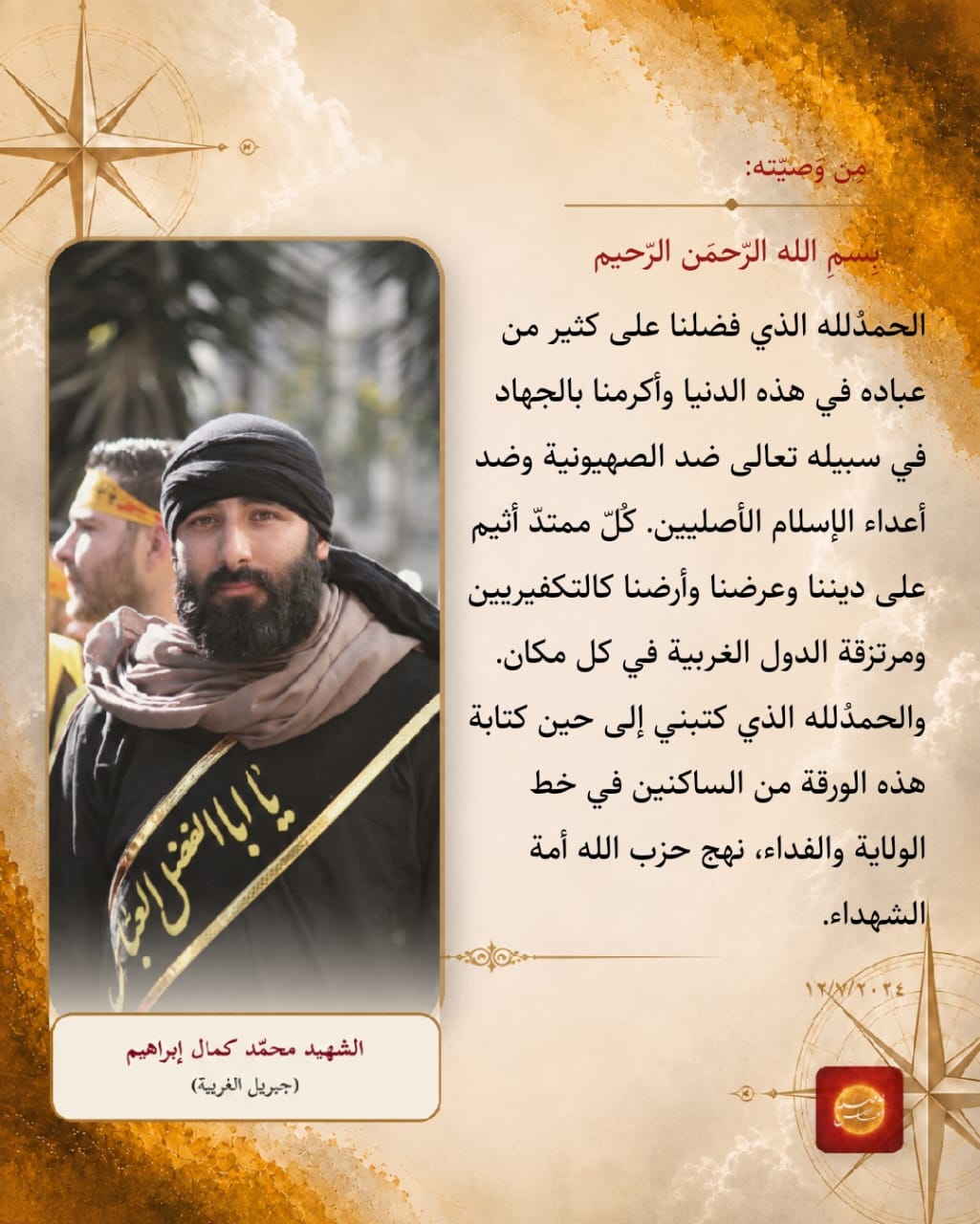
Media professional and storyteller Arwa Al-Jammal recounts the story of martyr Abbas Wahbi, whose mission in Wadi al-Salouq during the 66-day war was to deliver water to the people of Tayr Harfa.
“Along the way, the call to prayer was heard. It was the same call to prayer associated with Imam Hussein (peace be upon him). When they would tell him, ‘You may be martyred,’ he would respond, ‘What am I fighting for? I am fighting for prayer.’”
“Brother Abbas also said that he wanted to pray. The person in charge told him, ‘You cannot. We are going to be martyred, and we must deliver the water, just like Abu al-Fadl al-Abbas.’”
“Tears filled Abbas’s eyes at that moment. He was accustomed to praying at the very first moment he heard the voice rising from the earth toward the heavens: ‘Allahu Akbar.’ He would stand for prayer. He did not say, ‘I have work to do, I cannot pray.’ Rather, he would say, ‘Do not say you have work to do when it is time for prayer; say that you have prayer to attend to.’ That was Abbas.”
“His brother told him, ‘This is our duty.’ Shortly afterward, Abbas and his companion were martyred. His brother recounts: ‘Abbas’s right arm was severed, like Abu al-Fadl al-Abbas, the one who carried water to the thirsty. I placed it in the designated body bag, then kissed him on the forehead and asked his permission to leave.’”
“I swear to God, I returned twenty days after the war had ended. We opened the martyr’s body bag, and his face remained radiant as it was.”
“From my experience, I believe his face remained radiant because he wept for the sake of prayer. These are our martyrs. These are the models of Karbala.”
And so, a question emerges: Was the resemblance between Karbala and Abbas’s story inherent in the story itself? Or did the framework of narration select these particular details and connect them to the memory of Karbala?
“These are our martyrs. These are the models of Karbala.”